
Introduction: Why the Aravalli Mountain Range Matters
The Aravalli mountain range is not just a geological wonder but a lifeline for north-western India. Stretching across Delhi, Haryana, Rajasthan, and Gujarat, this ancient range plays a critical role in preventing desertification, regulating climate, and supporting biodiversity. However, decades of unregulated mining and urban expansion have pushed it to the brink.
Recognising the urgency, the Supreme Court of India has issued landmark directions to protect the Aravallis by defining clear ecological boundaries and regulating mining activities. These measures aim to balance environmental conservation with sustainable development. This article explains the latest Supreme Court intervention, why it matters, and what it means for the future of the Aravalli region.
Aravalli Mountain Range: Geographic and Ecological Significance
One of the Oldest Mountain Systems on Earth
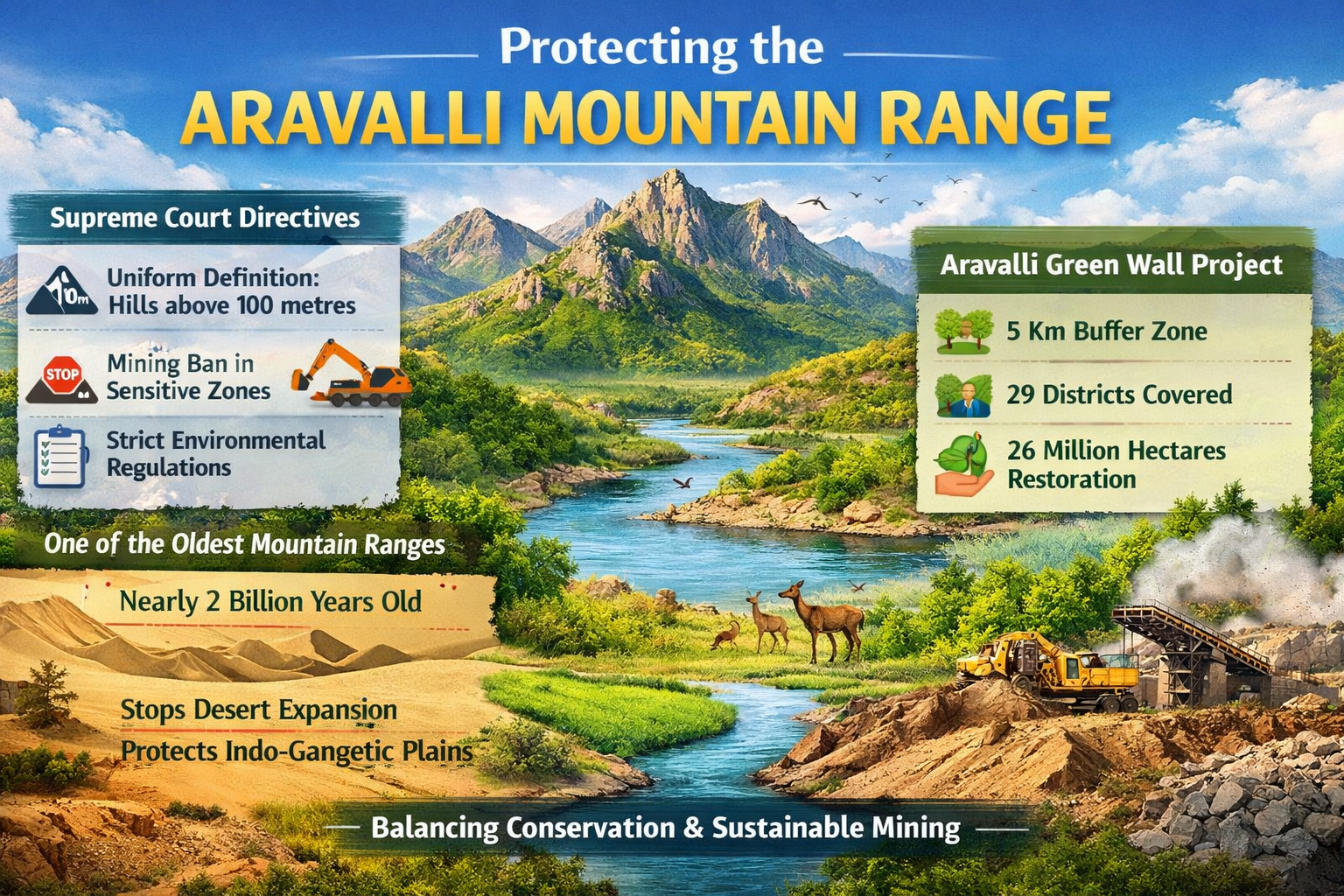
The Aravalli mountain range is estimated to be nearly two billion years old, making it among the oldest fold mountain systems in the world. It extends for about 650 kilometres, starting near Delhi and ending in Gujarat.
Ecological Importance of the Aravallis
The range serves as an ecological backbone for north-western India by:
- Acting as a natural barrier against the spread of the Thar Desert
- Supporting groundwater recharge and aquifers
- Regulating regional climate and rainfall patterns
- Providing habitat for diverse flora and fauna
Rivers and Natural Resources
Several major rivers such as the Chambal, Sabarmati, and Luni originate from or are sustained by the Aravalli system. The region is also rich in minerals including limestone, marble, copper, zinc, and sandstone, which has made it a major mining zone.
Mining in the Aravalli Range and Environmental Degradation
Rise of Mining Activities
Mining in the Aravalli mountain range expanded rapidly due to the availability of construction and industrial minerals. Despite environmental regulations introduced in the early 1990s, illegal and unregulated quarrying continued in many areas.
Environmental Impact of Excessive Mining
Uncontrolled mining has resulted in:
- Large-scale deforestation
- Sharp decline in groundwater levels
- Increased air pollution, especially in the NCR
- Loss of wildlife corridors and biodiversity
Earlier Judicial Interventions
In 2009, the Supreme Court imposed a mining ban in Haryana’s Faridabad, Gurugram, and Mewat districts. However, enforcement gaps and inconsistent definitions of the Aravallis limited the effectiveness of these measures.
Supreme Court’s Uniform Definition of the Aravalli Range
The Problem of Inconsistent Definitions
One of the biggest challenges in protecting the Aravalli mountain range was the lack of a uniform definition. Different States used different criteria, creating legal loopholes that allowed mining to continue.
Formation of an Expert Committee
To address this, the Supreme Court constituted a committee with members from:
- Ministry of Environment, Forest and Climate Change
- Forest Survey of India
- Geological Survey of India
- State Forest Departments
- Central Empowered Committee
- The 100-Metre Height Criterion
In 2025, the Court accepted the committee’s recommendation that all hills above 100 metres in height would be considered part of the Aravalli range. The Court observed that this approach was more practical and inclusive than earlier slope-based or buffer-based definitions.
Central Empowered Committee Recommendations
Science-Based Protection Strategy
The Central Empowered Committee proposed a comprehensive, data-driven approach to conserve the Aravalli mountain range.
Key Recommendations Accepted by the Court
The Supreme Court endorsed the following measures:
- Scientific mapping of the Aravalli region across all States
- Macro-level environmental impact assessment of mining activities
- Complete prohibition of mining in ecologically sensitive zones
- Ban on new mining leases and renewals until mapping is completed
- Strict regulation of stone-crushing units to control air pollution
These recommendations were formally accepted in the Court’s November 2025 order.
Sustainable Mining and the Aravalli Green Wall Project
A Balanced Judicial Approach
Instead of a total mining ban, the Supreme Court allowed existing legal mining operations to continue under strict conditions. The Court noted that absolute bans often lead to illegal mining and criminal networks.
The Aravalli Green Wall Initiative
In June 2025, the Central Government launched the Aravalli Green Wall Project, complementing judicial efforts.
Key Features of the Green Wall Project
- Covers a 5-kilometre buffer zone around the Aravalli range
- Spans 29 districts across Delhi, Haryana, Rajasthan, and Gujarat
- Aims to restore 26 million hectares of degraded land by 2030
- Supports India’s commitment to land degradation neutrality
This initiative focuses on afforestation, soil conservation, and water restoration.
Frequently Asked Questions (FAQs)
What is the Aravalli mountain range known for?
The Aravalli mountain range is known for being one of the world’s oldest mountain systems and for preventing desertification in north-western India.
Why did the Supreme Court intervene in Aravalli mining?
The Court intervened due to widespread illegal mining, ecological degradation, and the lack of a uniform definition of the Aravalli region.
What is the new definition of the Aravalli range?
According to the Supreme Court, all hills above 100 metres in height are considered part of the Aravalli range.
Is mining completely banned in the Aravallis?
No, existing legal mining is allowed under strict regulations, but new mining leases and renewals are currently paused.
What is the Aravalli Green Wall Project?
It is a government initiative aimed at increasing green cover and restoring degraded land around the Aravalli mountain range.
Which States are covered under the Supreme Court’s directions?
The directions apply to Delhi, Haryana, Rajasthan, and Gujarat.
Conclusion: A Turning Point for the Aravalli Mountain Range
The Supreme Court’s latest directions mark a crucial step in safeguarding the Aravalli mountain range for future generations. By introducing a uniform definition, halting unregulated mining, and promoting sustainable practices, the Court has laid the foundation for long-term ecological recovery.
However, success will depend on effective implementation by States, scientific monitoring, and public awareness. Protecting the Aravallis is not just an environmental priority but a necessity for climate resilience and water security in India.
Call to action: Support conservation efforts, stay informed, and advocate for responsible development to ensure the Aravalli range continues to protect India’s ecological future.
You may also like :- Education, Automobile, Make Money Online, Finance, Technology, Sports, Entertainment,
Follow Us :- Facebook, Instagram, Twitter
About The Author
